
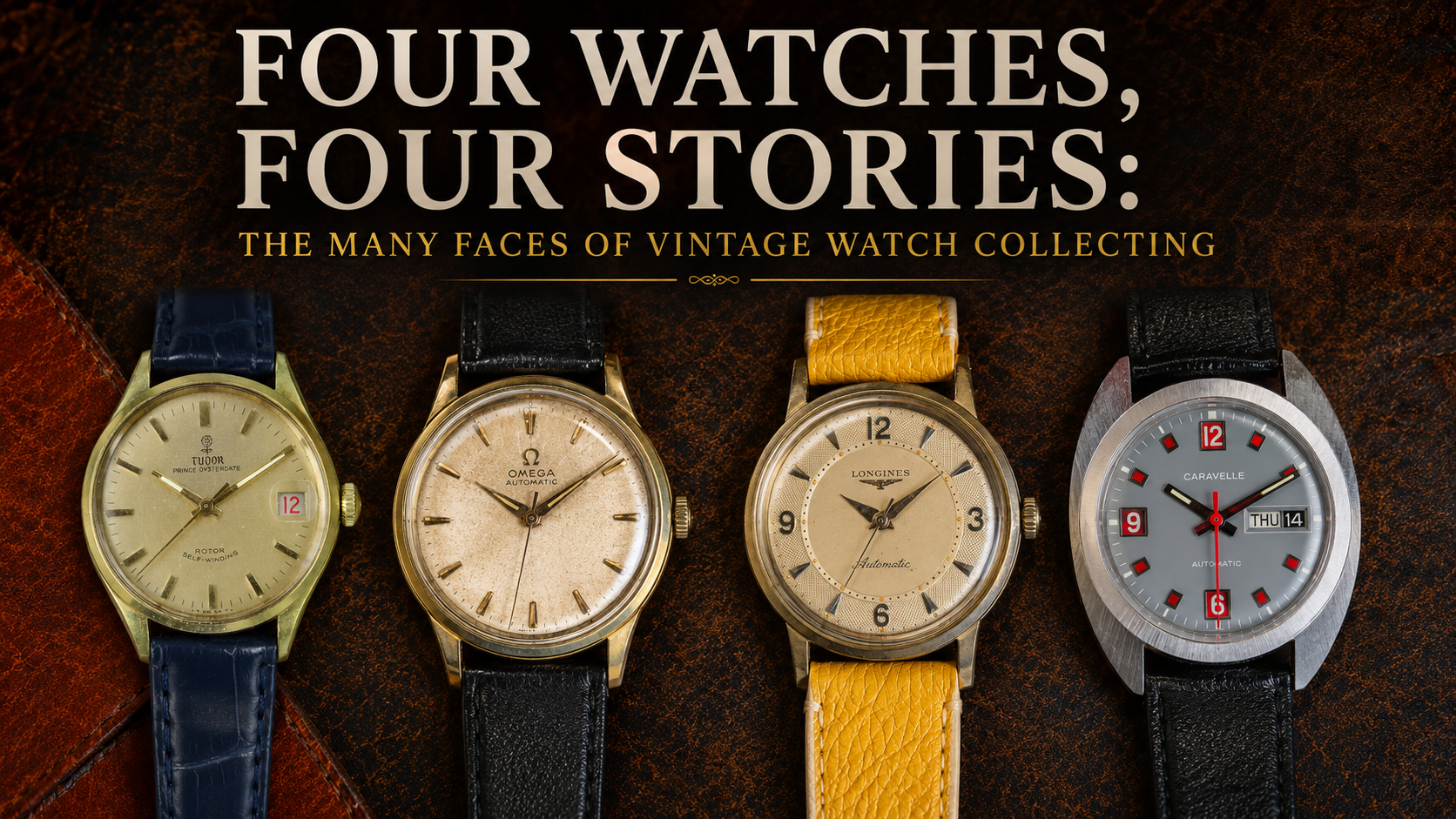
We're back! Four Watches, Four Stories: The Many Faces of Vintage Watch Collecting
There is something about a vintage watch that makes it difficult to look at it simply as an object for telling time.
A modern watch can certainly be beautiful, technically impressive, or historically significant, but a vintage watch carries something that cannot be designed into a new production piece: a history of its own. The marks on a case, the fading of a dial, the replacement of a crown, or even a seemingly insignificant stamp inside the case can tell us something about where a watch came from, how it was made, and the life it has lived.
This is part of what makes vintage watch collecting so rewarding. The more you look, the more you begin to notice.
A collection does not need to be made up exclusively of rare references or complicated watches. In fact, some of the most enjoyable watches to collect are those that invite you to look a little closer. A familiar name can reveal an unusual case maker. A seemingly simple automatic can contain a historically important movement. Two date stamps can tell us that a watch was assembled over more than one year.
The four watches featured here are a good example.
Spanning from 1957 to 1973, they come from four different corners of vintage watchmaking: Longines, Omega, Tudor, and Caravelle. They differ in size, design, construction, and character, yet each has something that makes it worth studying.
More importantly, each demonstrates a different reason to appreciate vintage watches.
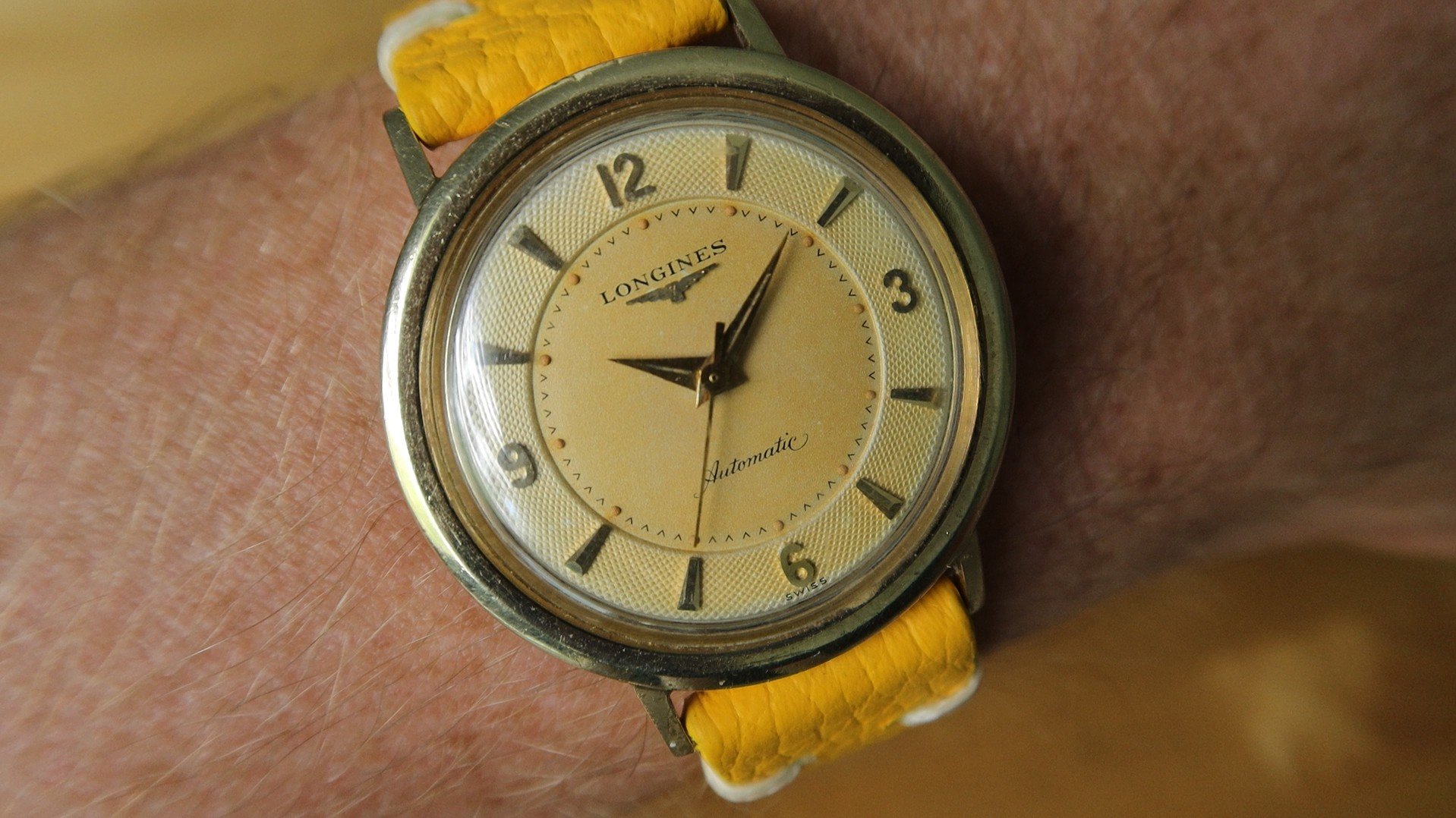
The first watch takes us back to 1957, to a period when automatic winding was becoming an increasingly important part of everyday Swiss watchmaking.
This Longines Reference 1042 is a wonderfully restrained example of mid-century design. Measuring approximately 33mm, its proportions are distinctly of their era, but they give the watch an elegance that remains remarkably easy to appreciate today.
The dial is the first thing that draws you in.
A warm champagne or gold-toned surface is framed by a finely textured outer section, adding subtle depth to an otherwise understated design. Applied Arabic numerals mark 12, 3, 6, and 9, while baton markers fill the remaining hours. Dauphine-style hands and a sweeping central seconds hand complete the composition.
What makes this particular example especially appealing is the way time has affected the dial.
Rather than appearing uniformly preserved, it has developed a natural patina that gives the champagne surface a warmer, more complex appearance. The domed crystal reinforces the watch's mid-century character, while a yellow leather strap adds a touch of personality.
Inside is the Longines caliber 19AS, an automatic movement from one of the company's most important postwar movement families. The Longines caliber 19AS is a self-winding mechanical movement introduced in the early 1950s and derived from Longines' earlier 19A family. Measuring approximately 25.4mm in diameter, the 19AS beats at 18,000 vibrations per hour and has a power reserve of roughly 39 hours. Depending on the specific variant, the movement was produced with either 17 or 19 jewels; examples with indirect center seconds, like the movement in this watch, are among the defining configurations of the 19AS.
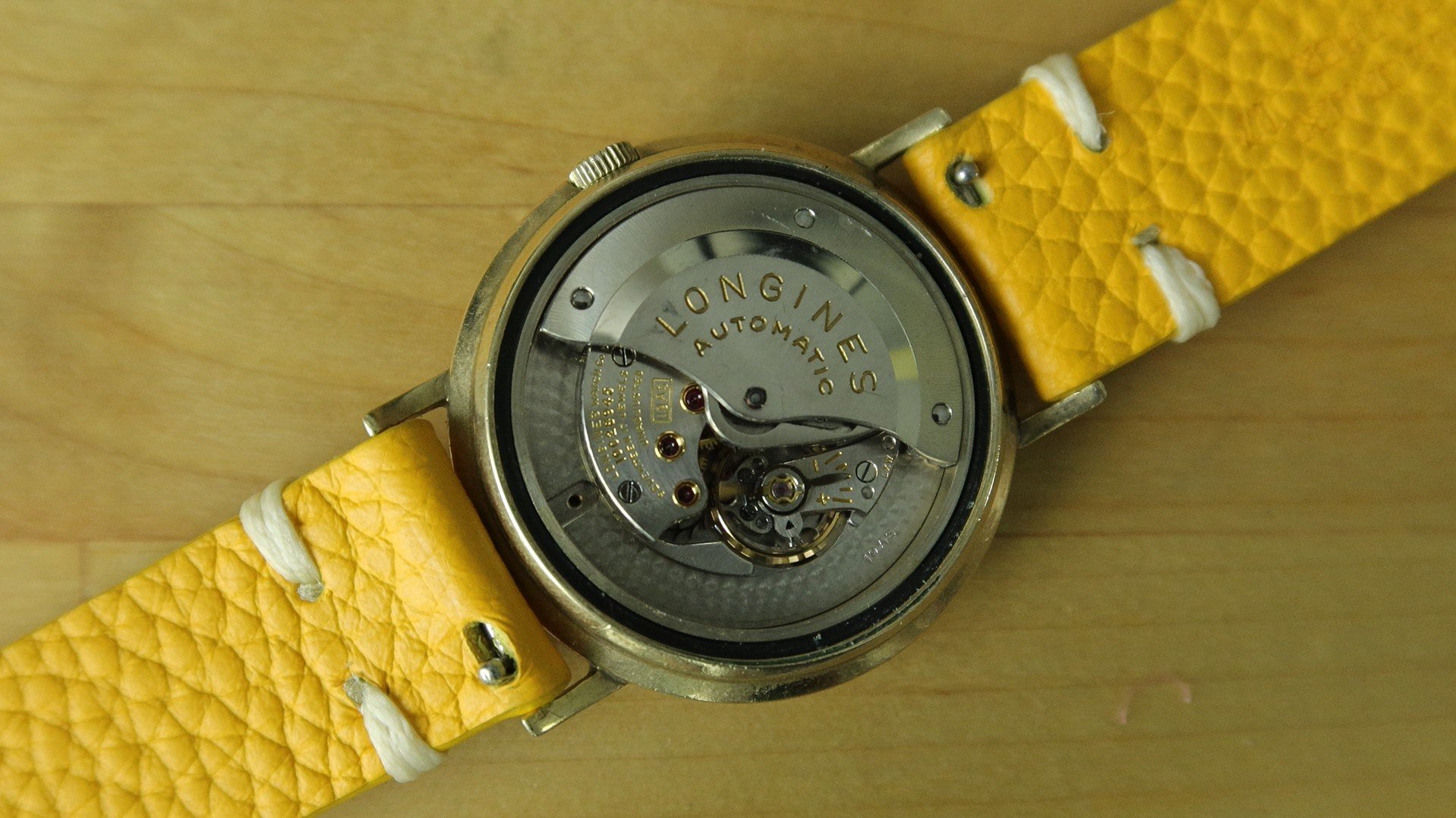
But there is another detail that makes this watch particularly interesting to a collector.
The case carries the S&W mark associated with Schwab & Wuischpard, a New York case manufacturer. This points toward an important but sometimes overlooked aspect of vintage Swiss watches sold in the United States: the movement and case did not necessarily have to be manufactured by the same company or even in the same country.
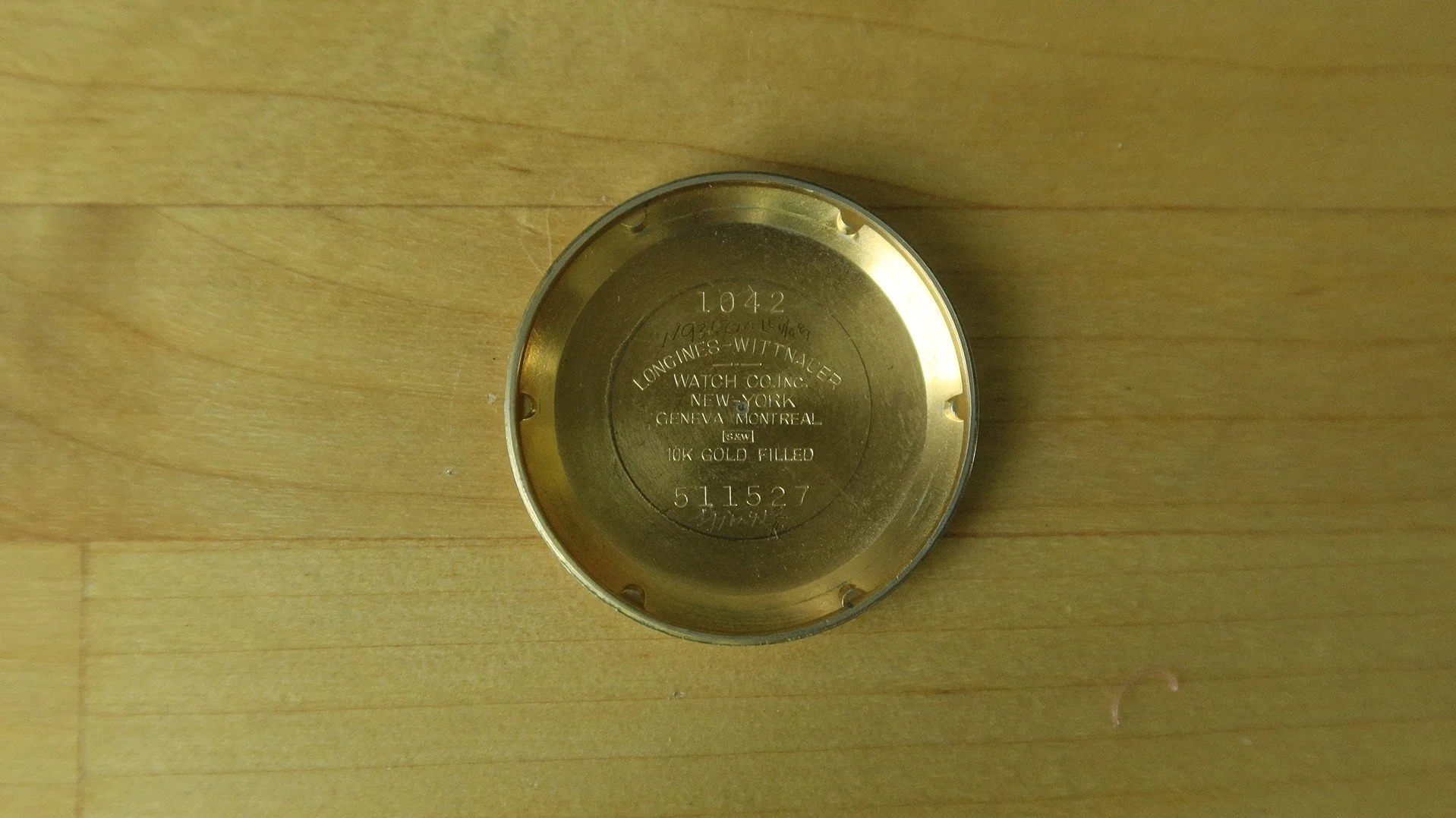
Swiss watchmakers could supply the movement while an American case manufacturer produced the case for the domestic market. The result is a watch that is Swiss in its mechanical heart while also carrying a small piece of American manufacturing history on its case.
It is an easy detail to overlook.
And that is precisely why vintage watches are so much fun.
The Reference 1042 does not announce its history. You have to look for it.
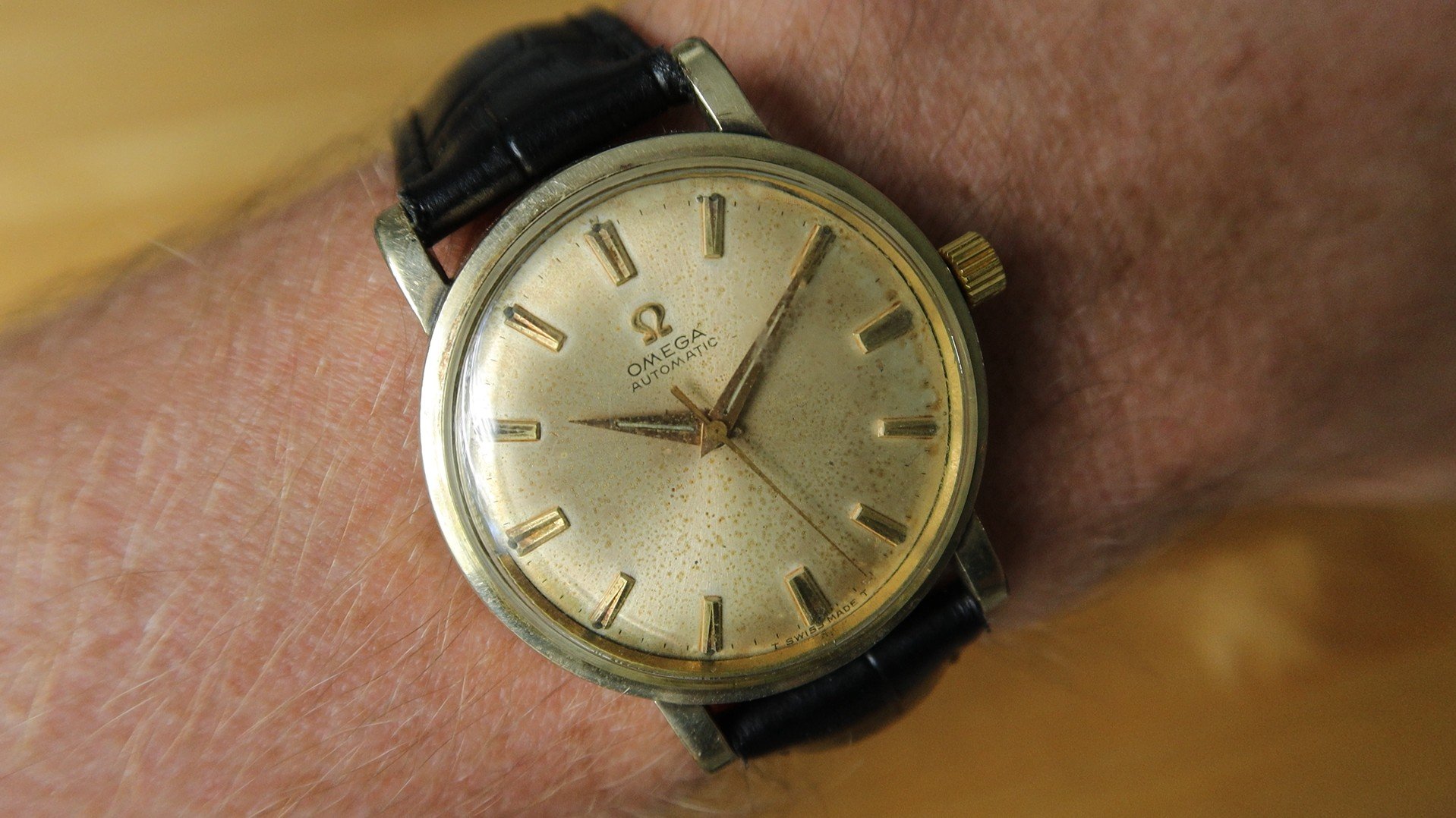
Nearly a decade later, we arrive at another understated automatic dress watch, this time from Omega.
The Reference LLU 6289 dates to 1966 and is powered by Omega's caliber 550 automatic movement. Like the Longines, it measures approximately 33mm, reflecting the smaller proportions that were standard for men's watches during the period.
Yet despite the similarities, the Omega has an entirely different personality.
Its champagne-toned dial has aged to a creamy, warm color, with fine spotting and patination that give the surface an unmistakably vintage appearance. Applied gold-tone baton markers provide structure, while slender dauphine-style hands and a central seconds hand maintain the clean, elegant aesthetic associated with Omega's dress watches of the period.
The movement is one of the highlights.
Omega's caliber 550 belongs to the company's highly regarded 550 family of automatic movements, a series that helped establish Omega's reputation for reliable, everyday mechanical watches during the 1950s and 1960s. The movement features a central sweep seconds hand and Omega's automatic winding system, and was designed as a robust, relatively straightforward movement for everyday use. The 550 family became particularly well regarded for its combination of reliability, serviceability, and understated engineering—qualities that helped establish Omega's reputation for dependable mechanical watches during this period.
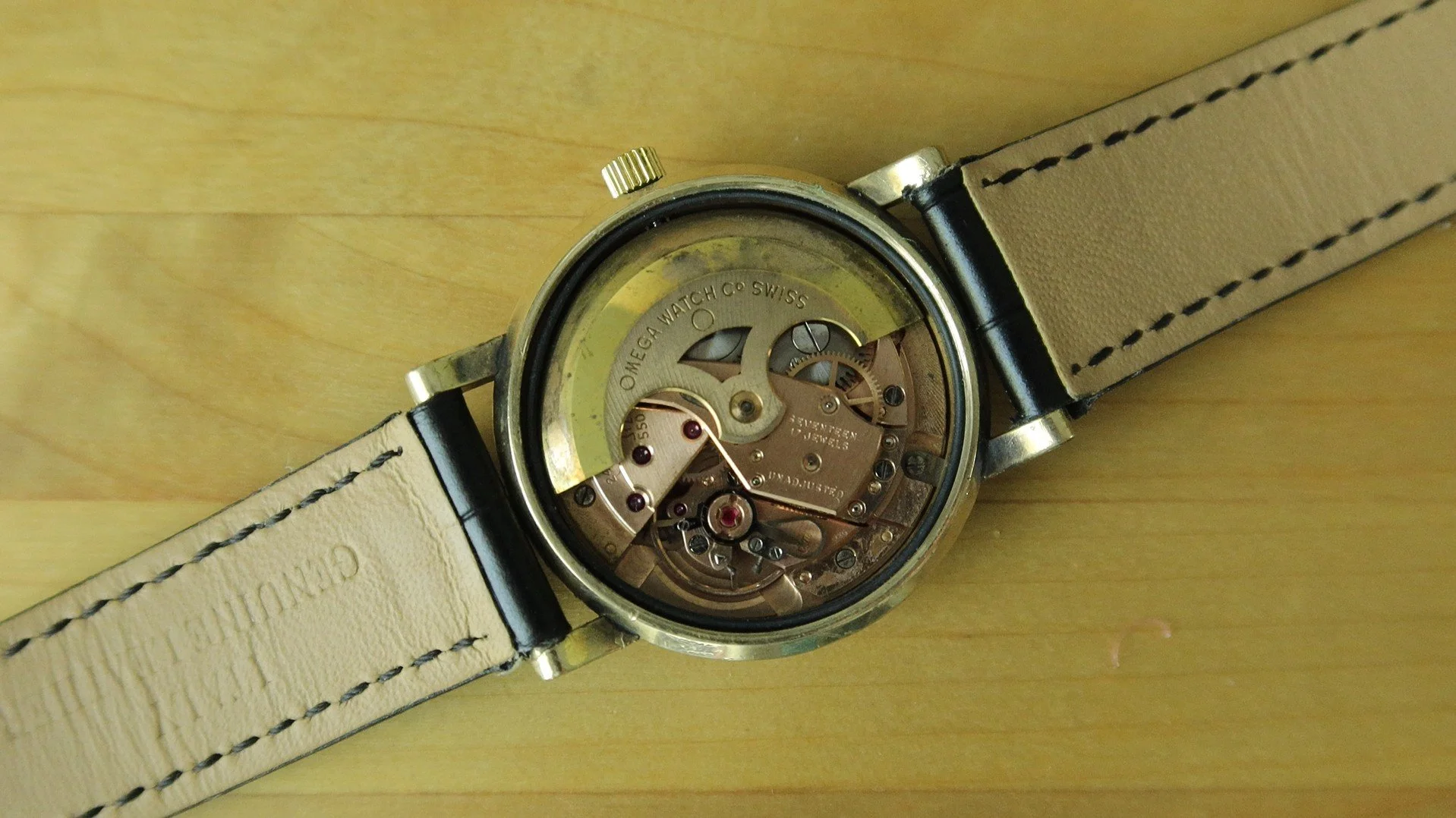
The case, however, reveals another layer of the story.
This example is housed in a 10K gold-filled case bearing the Ross case maker's mark. Like the Longines above, it illustrates the relationship between Swiss watch manufacturers and American case makers during the period when watches were being prepared specifically for the United States market.
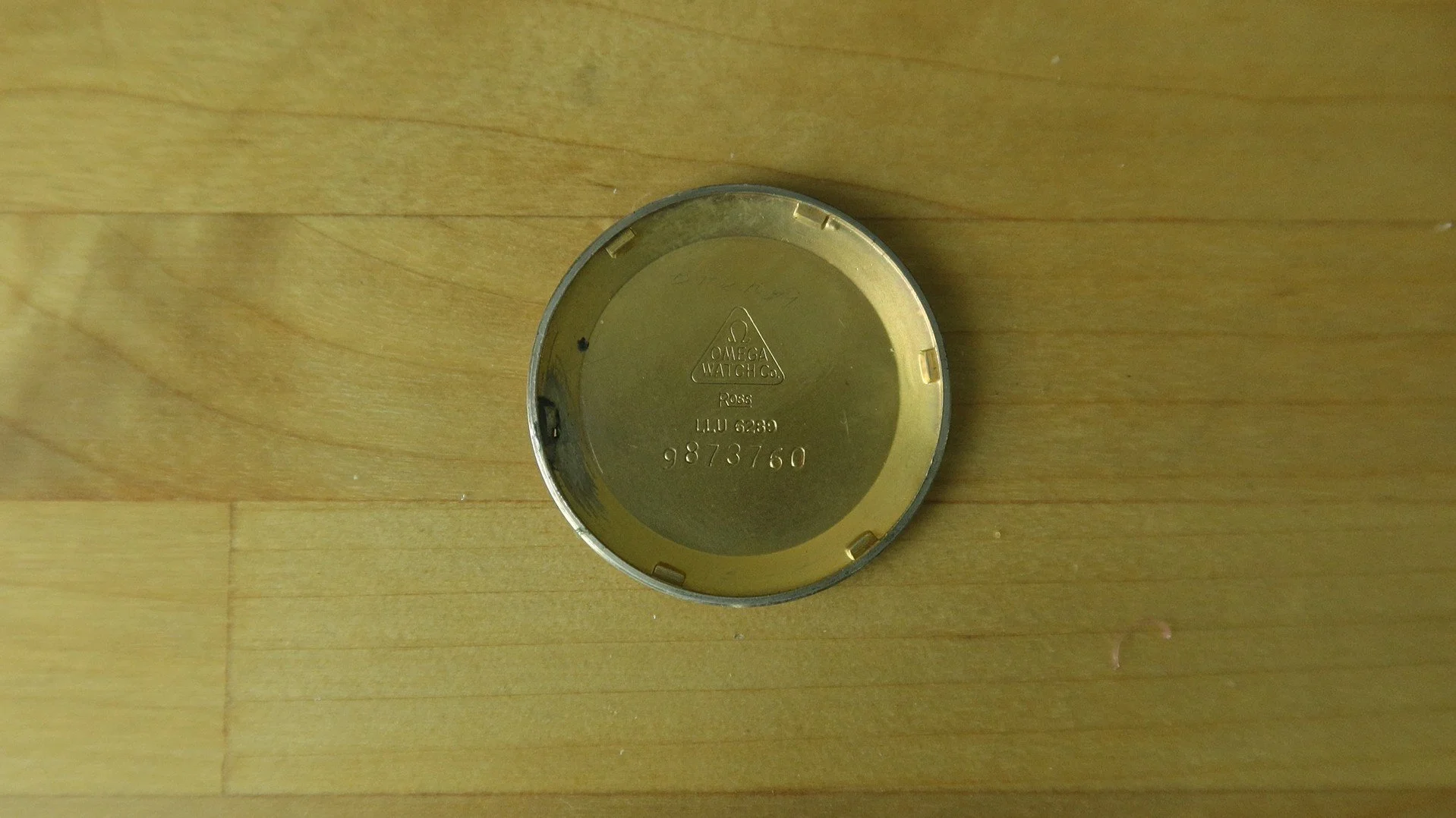
It is a fascinating reminder that a vintage watch can have more than one geographical identity.
There is Switzerland in the movement. There is American manufacturing in the case. And there is nearly sixty years of history in the dial and case surfaces.
The watch also carries the honest signs of that history. The Omega-signed crown appears to be a replacement, while the caseback shows scratches, scuffs, and other surface wear.
For some collectors, those imperfections might be something to correct.
For others, they are part of the appeal.
A vintage watch does not always need to look untouched. Sometimes the evidence that it was actually worn is what makes it feel alive.
The Reference LLU 6289 is a perfect example: understated, mechanically interesting, and full of the small details that reward a closer look.
Tudor Prince Oysterdate Reference 7970 - The Rolex Connection
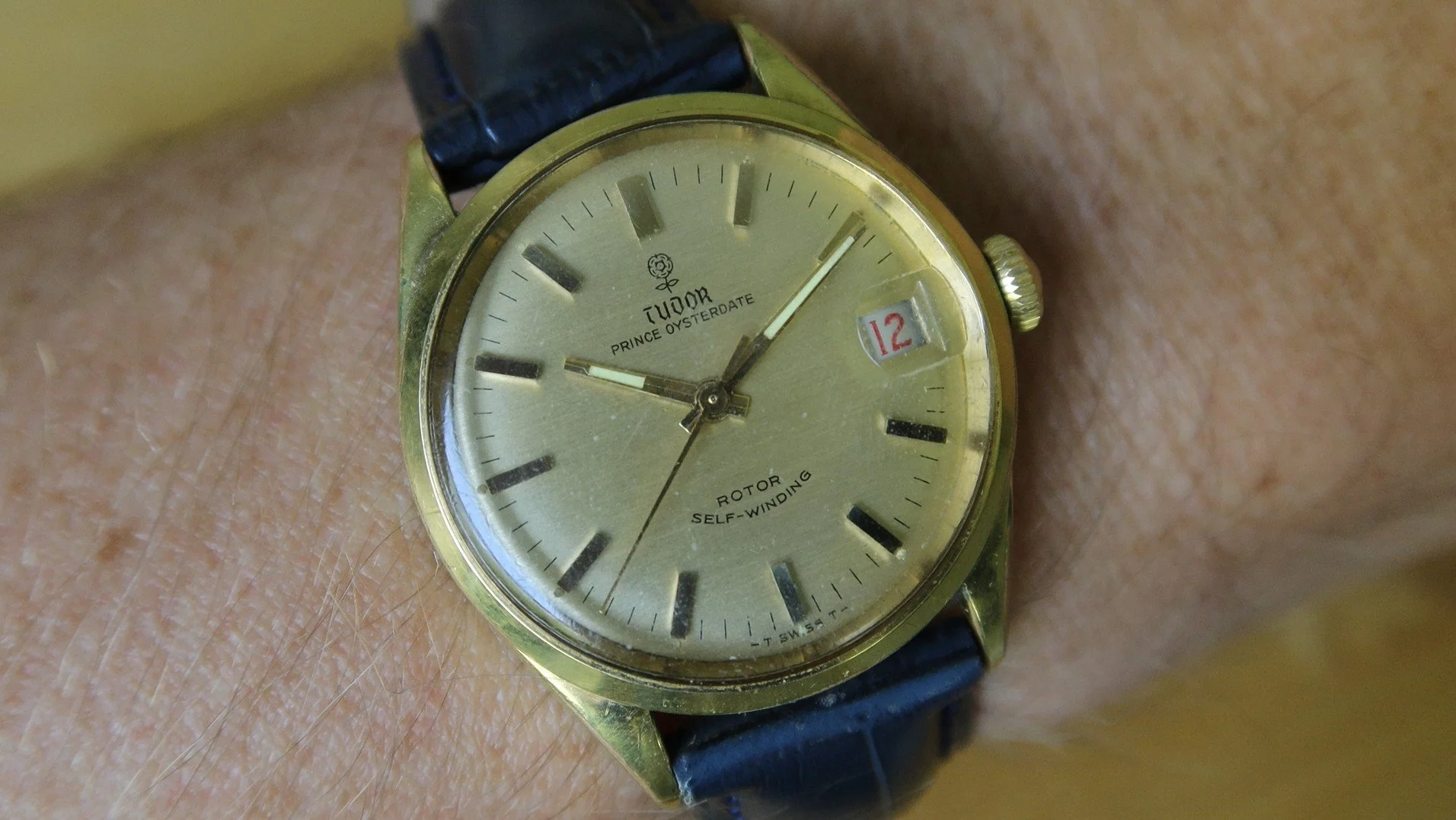
The third watch takes us into one of the most fascinating relationships in vintage watchmaking: Tudor and Rolex.
This Tudor Prince Oysterdate Reference 7970 dates to approximately 1966 and has a very different presence from the two dress watches above.
It is still relatively compact at approximately 33mm, but the Oyster case gives it a more substantial and purposeful character. The case is gold plated, with a stainless-steel screw-down caseback carrying the inscription: “Original Oyster Case by Rolex Geneva.”
For anyone interested in vintage Tudor, that inscription immediately makes the watch more interesting.
Tudor was established by Hans Wilsdorf and developed alongside Rolex, sharing much of the parent company's expertise and infrastructure. The Oyster case became one of the defining elements of Tudor's identity, just as it had been for Rolex.
The Reference 7970 takes that familiar formula and adds another detail that makes it particularly charming: the date.
At 3 o'clock is a red-and-black date wheel, commonly referred to by collectors as a roulette date. Against the otherwise restrained dial, the alternating colors provide a subtle but distinctive flash of character.
The dial itself is classic Tudor, with applied baton markers, slender hands, a central seconds hand, and the Tudor rose beneath 12 o'clock.
Then there is the crown.
Rather than carrying the Rolex coronet, this example is signed “Oyster Patent.”
It is a small detail, but one that makes the watch particularly interesting. Along with the Rolex-marked Oyster caseback, it provides a tangible reminder of the close relationship between Tudor and Rolex during this period.
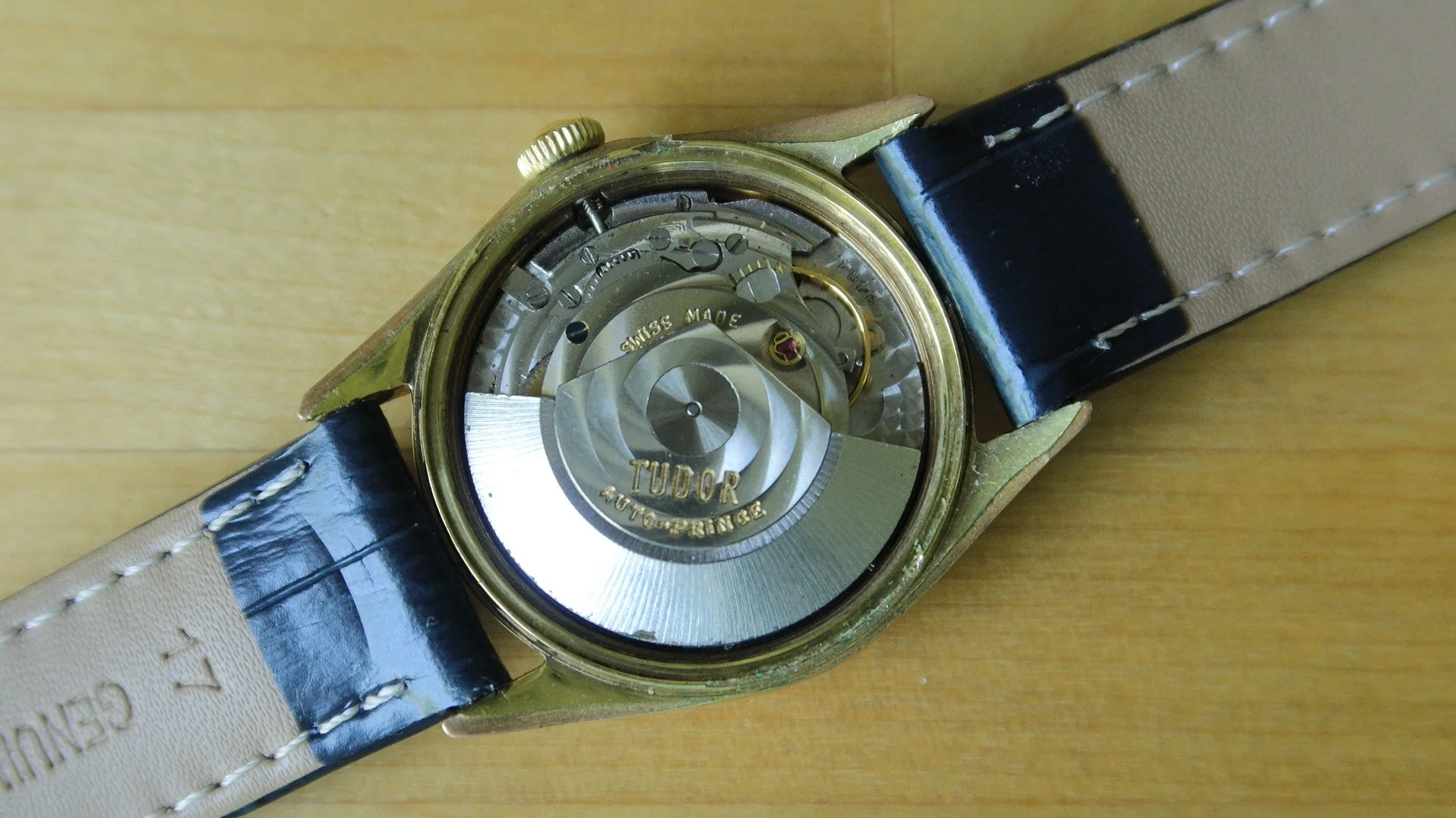
Inside is Tudor caliber 2484, an automatic movement with date functionality and a movement family closely related to ETA's 2452 architecture. The caliber is a 25-jewel automatic movement measuring 25.6mm in diameter and approximately 5.3mm thick. It beats at 18,000 vibrations per hour and provides a power reserve of approximately 42 hours, with central hours, minutes, seconds, and a date display at 3 o'clock.
Like the other watches in this group, the Tudor also shows the effects of time. The gold plating has worn in places, particularly around the case and lugs, while the dial has developed its own natural aging.
Again, these are not necessarily things that need to be erased.
They tell us that this was a watch that was worn.
And perhaps that is fitting for an Oyster Prince.
The Reference 7970 combines Rolex's famous Oyster case construction with Tudor's more accessible approach to watchmaking, creating a watch that is understated on the wrist but full of details for the collector who takes the time to investigate it.
Caravelle Automatic Day-Date - A Different Side of the 1970’s
Then there is the Caravelle.
If the Longines represents the elegance of the 1950s, the Omega the understated refinement of the 1960s, and the Tudor the Rolex-influenced practicality of the same period, this Caravelle takes us somewhere completely different.
It is unmistakably 1970s.
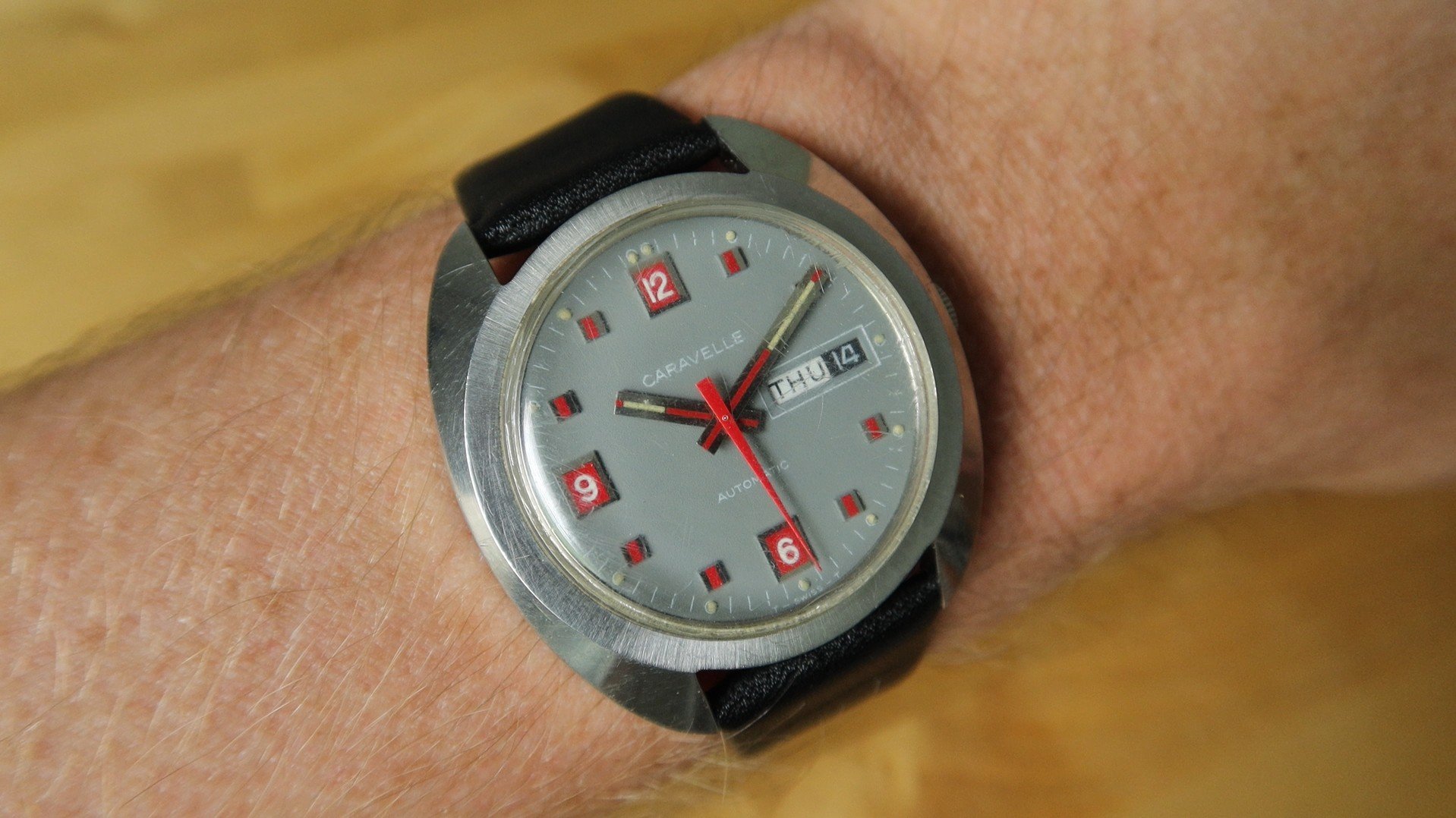
The case measures approximately 38mm and has the angular, architectural shape that became increasingly common during the decade. Brushed and polished surfaces play against one another, while the large lugs and prominent domed acrylic crystal give the watch a strong presence on the wrist.
And then there is the dial.
Gray, black, red, and luminous elements come together in a combination that could hardly belong to another era. Large applied Arabic numerals appear at 12, 6, and 9, with rectangular markers filling the remaining hours. The bright red hands and central seconds hand provide an unexpected contrast against the gray dial.
At 3 o'clock is a day-date display, giving the watch a useful complication in addition to its unmistakable visual character.
But beneath the dial is where things become particularly interesting.
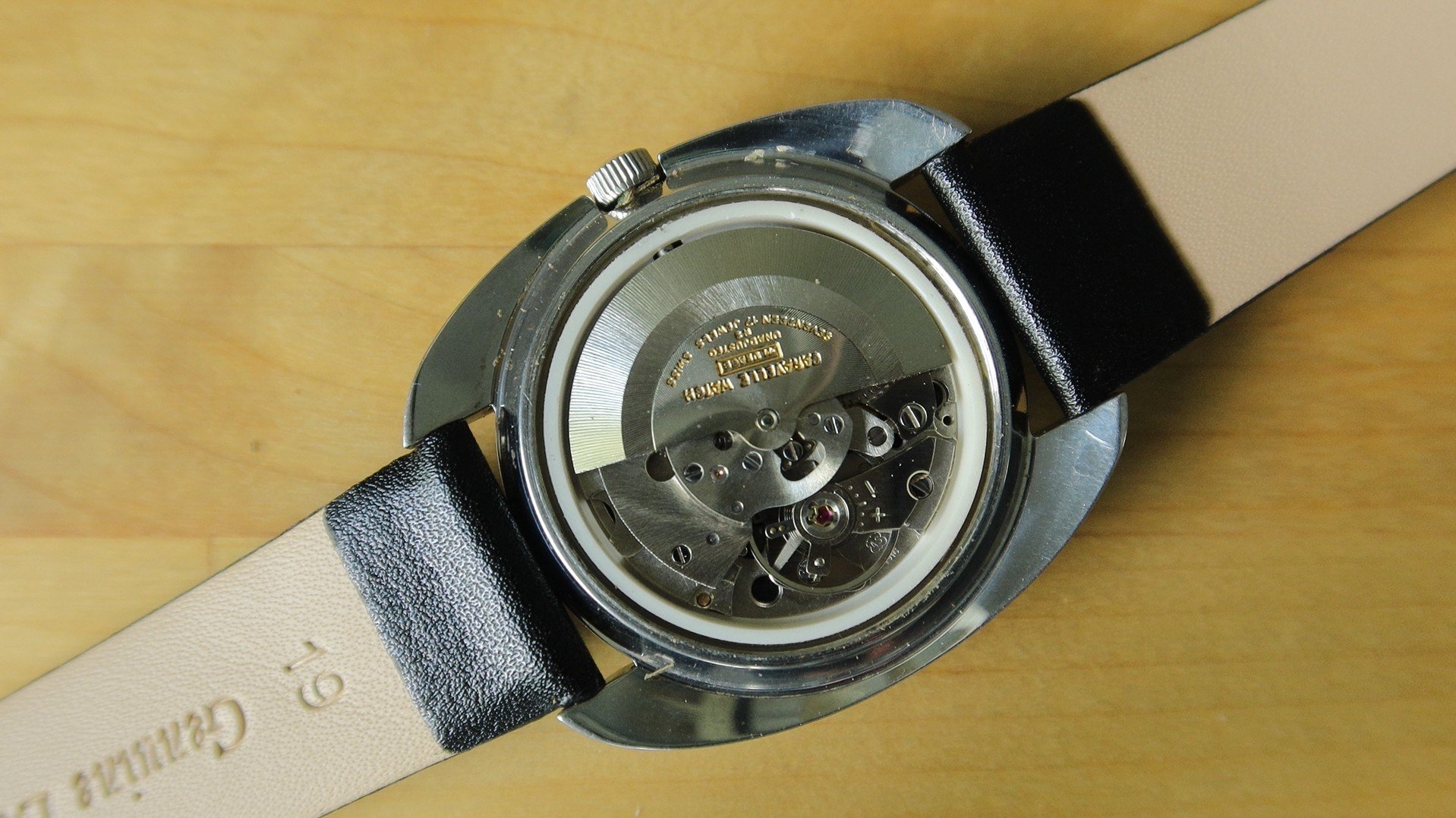
The watch is powered by Caravelle caliber 11UKACB, a designation associated with the A. Schild AS 1916 movement. The AS 1916 was a Swiss automatic movement offering central seconds and day-date functionality, making it a fitting mechanical choice for a watch like this. The caliber is based on the Swiss A. Schild 1916, a self-winding movement measuring 25.6mm in diameter and approximately 5.95mm thick. It operates at 21,600 vibrations per hour and incorporates both day and date displays, with quick date-setting functionality; period documentation identifies the AS 1916 as a development derived from the AS 1906. The movement's relatively modern 21,600 vph frequency and practical day-date mechanism made it well suited to the more utilitarian character of watches produced in the early 1970s.
There is also a small chronological mystery hidden inside the case.
The movement is stamped N2, indicating 1972, while the case is stamped N3, indicating 1973.
At first glance, the discrepancy might seem unusual. But it is actually a wonderful example of how watches were assembled in the real world. Movements and cases were components that could be manufactured, stocked, and assembled at different times. In this case, a 1972 movement appears to have been fitted into a case produced in 1973.
Rather than diminishing the watch, the difference gives us another piece of information about its construction.
And this is exactly the kind of detail that can turn an ordinary-looking vintage watch into an engaging research project.
Caravelle was part of the Bulova family, and its watches occupied a very different place in the market from the likes of Omega, Longines, and Tudor. But that does not mean they lack horological interest. Quite the opposite.
The 11UKACB gives this watch a genuine Swiss mechanical pedigree, while the bold case and dial capture the design language of the early 1970s beautifully.
It is a reminder that interesting vintage watches can be found well beyond the most obvious names.
Four Watches, Four Personalities
Placed together, these four watches tell a surprisingly broad story about vintage watchmaking.
The Longines Reference 1042 is restrained and elegant, its appeal coming from its proportions, patinated champagne dial, Longines caliber 19AS, and the unexpected American connection revealed by its case maker's mark.
The Omega Reference LLU 6289 offers a similarly understated aesthetic, but with its own personality—an aged champagne dial, Omega caliber 550, and 10K gold-filled Ross case.
The Tudor Prince Oysterdate Reference 7970 takes a more utilitarian approach, combining the Oyster case, roulette date, Tudor branding, and unmistakable Rolex connection in a compact package.
And the Caravelle Automatic Day-Date moves decisively into the 1970s, with its 38mm angular case, colorful gray-and-red dial, day-date display, and A. Schild-based automatic movement.
None of these watches is trying to be everything. And that is precisely what makes them interesting.
One of the great pleasures of collecting vintage watches is discovering that there is no single definition of what makes a watch worth owning. Some collectors are drawn to rarity. Others care about movements, design, provenance, condition, or historical significance. Still others simply see a watch across a room and know that something about it speaks to them.
Often, the best watches combine several of these qualities. But sometimes it is the smallest detail that makes the difference.
A case maker's stamp.
A crown that says “Oyster Patent.”
A roulette date wheel.
A movement made one year before the case.
A dial that has spent decades slowly changing color.
These are the details that reward curiosity.
And the more vintage watches you encounter, the more you begin to notice them. You start looking beyond the name on the dial and asking how the watch was made, where it was made, who supplied its case, what movement is inside, and what happened to it during the decades between its manufacture and the present day.
Eventually, the watch becomes more than an object.
It becomes a story. That, more than anything, is what keeps vintage watch collecting interesting. And sometimes the most compelling stories are found in watches that, at first glance, might seem quite ordinary.


